
Nemaha Projected Versus Actual Release
A projected release date is KDOC’s current forecast based on the sentence structure, credited time, and authorized credits then recorded. It is not the event of walking out of an institution. An actual release date records a movement that occurred. KASPER may also show parole eligibility, conditional release, supervision, expiration, or discharge. Each label answers a different question, so it should be copied exactly rather than shortened to “release date.”
A Nemaha County pretrial detainee usually has no computed prison release date. Custody depends on bond, court orders, dismissal, trial, or sentencing. A person serving a local jail sentence may have an end date documented by the sentencing order and Sheriff’s jail record. A person committed to the Secretary of Corrections enters KDOC’s sentence-computation system.
A scheduled date can change. The actual movement record and release authority provide the final confirmation.
Find a Nemaha Release Date
Choose the source by custody type. The Nemaha Sheriff roster is a live county-jail list and does not publish a projected release field. KASPER covers adults committed to Kansas correctional custody or supervision. The court file establishes the sentence and later changes. When labels conflict, request the agency’s existing calculation and movement fields rather than trying to compute an individual date from public fragments.
- Confirm whether the person is pretrial, serving county jail time, or committed to KDOC.
- For KDOC, open the KASPER disclaimer and search by KDOC number or exact name.
- Match identity, convictions, sentence information, custody or supervision status, and every displayed date label.
- For a county sentence, ask the Sheriff for the jail movement record and inspect the Nemaha court sentencing entry.
- For a date mismatch, use the KDOC online records portal to request the public calculation fields.
The KASPER name and KDOC-number form shows the available search route.
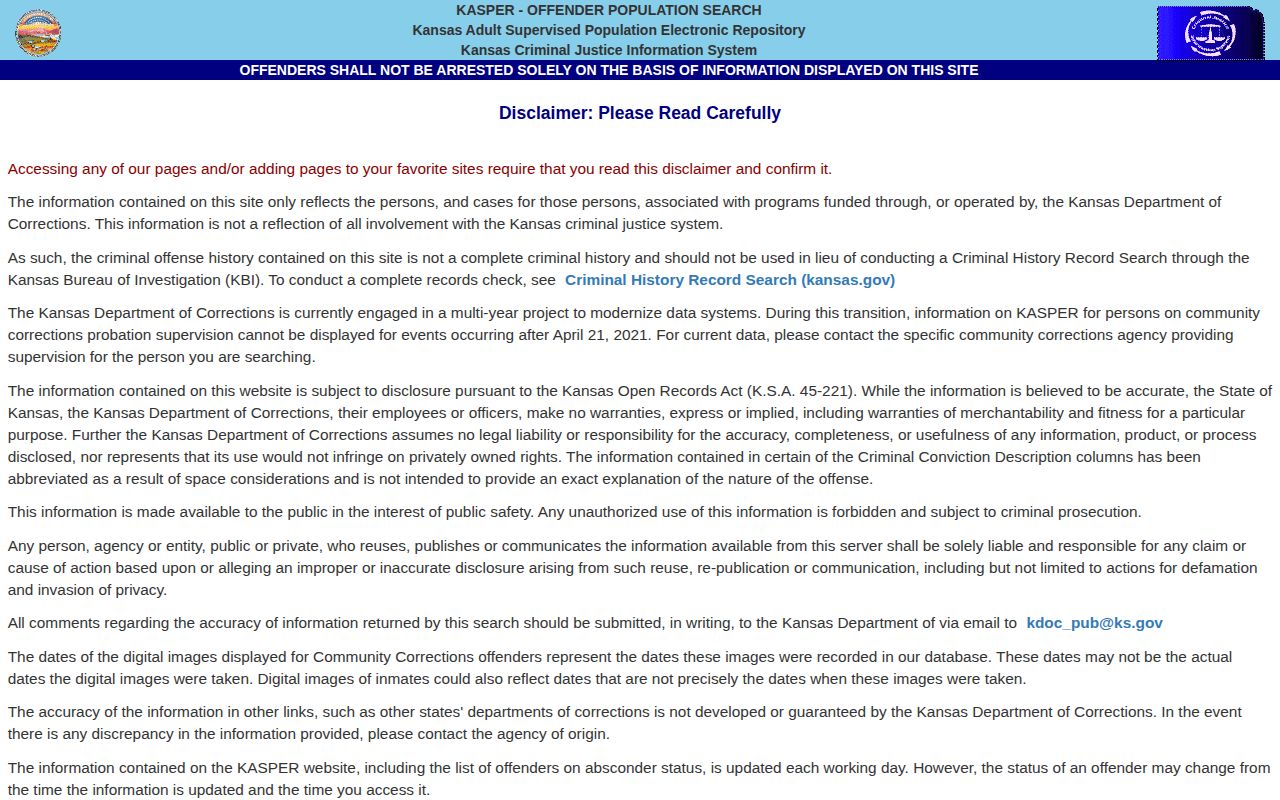
The state identifier is more precise than a name, while the result must still be checked against the correct person and sentence.
Read Nemaha KDOC Date Labels
KASPER public data can show sentence and custody dates, anticipated release concepts, institution or supervision status, and discharge information. Labels and completeness vary by sentence era. “Parole” or “postrelease” means the person left the prison institution but remains under KDOC control. “Discharged” ordinarily means KDOC custody and supervision ended for the represented sentence, subject to careful review of other sentences or cases.
- Anticipated release
- KDOC’s current forecast, not a completed movement.
- Parole eligibility
- The point at which an older indeterminate sentence may receive a suitability decision.
- Postrelease
- A community supervision term after the prison portion of a guideline sentence.
- Discharge
- The end of KDOC control for the record or sentence shown.
A county-jail release is not a KDOC discharge. Likewise, disappearance from the Nemaha jail roster does not supply a date or destination. The Sheriff’s release line and the court order remain the local sources.
Kansas Credits Shape Nemaha Dates
K.S.A. 21-6821 governs good-time and program credits for guideline sentences. The common 85-percent shorthand reflects a category with up to 15 percent good time, if all authorized credit is earned and retained. It is not a universal rule for every Kansas sentence. Some qualifying categories permit up to 20 percent, while special offenses and sentence dates carry other rules.
For a simple illustration, a 100-month prison portion in a 15-percent category could be reduced by at most 15 months, producing 85 months in prison if all credit is earned and retained. In a qualifying 20-percent category, the simplified figure could be 80 months. Neither example calculates a real person’s date. Jail credit, consecutive cases, program credit, forfeiture, special offense law, and court changes can alter the result.
Credits may also affect the postrelease portion rather than merely erase time from the full correctional relationship. The Prisoner Review Board process explains that the postrelease term for a determinate sentence begins at the maximum less authorized credits under applicable law. Specified sexual sentences have an express rule adding credited time to postrelease supervision.
Older Nemaha Sentence Dates Differ
Pre-guidelines indeterminate sentences use a different set of landmarks. Minimum term, parole eligibility, conditional release, and maximum release are not modern determinate-sentence equivalents. K.S.A. 22-3725 provides the older good-time table. The Prisoner Review Board describes parole eligibility after the minimum less applicable credit, conditional release at the statutory point tied to the maximum, and maximum release as sentence satisfaction.
The monthly public-comment calendar is not a release list. It identifies people approaching parole-related consideration and uses a cadence that can put a hearing before a possible later release month. A “Continue” means the Board needs more information, votes, or an evaluation. A “Pass” is a denial for a stated period. KASPER later shows custody or supervision status, while a specific historical decision may require a KDOC or Board record request.
Why Nemaha Release Dates Change
A forecast changes when one of its inputs changes. Public date labels may also appear to conflict because they describe different stages. The controlling sentence structure, not a hand calculation, governs.
| Factor | Possible effect | Confirm with |
|---|---|---|
| Earned credit | Moves the anticipated institutional date when authorized | KDOC calculation |
| Credit forfeiture | Can move a forecast later | KDOC record |
| Jail credit | Changes the sentence-begins computation | Journal entry and KDOC |
| Concurrent or consecutive cases | Changes the controlling sentence structure | Filed sentencing orders |
| Detainer or warrant | Can cause transfer instead of community release | Movement and receiving-agency records |
| Revocation or court change | Can interrupt or alter the chronology | Court docket and KDOC |
Do not reverse-engineer a personal release date from the sentence alone. A later court order, another county case, or an institutional movement may not be clear from a single public screen.
Request Nemaha Sentence Calculations
For a discrepancy, ask KDOC for the existing public sentence-structure and movement fields tied to the KDOC number. Useful terms include controlling sentence, sentence-begins date, anticipated guidelines release date, actual movement date and type, supervision start and end, expiration, and certificate or date of discharge. That wording separates forecasts from events without asking staff to create a new explanation.
KDOC’s general contact is 714 SW Jackson Street, Suite 300, Topeka, Kansas 66603, telephone 785-296-3317, and email KDOC_Pub@ks.gov. The online request portal permits a requester to submit and track a request. For the local custody episode, the Nemaha County Sheriff’s written KORA route should be used instead.
Nemaha Parole Dates and Decisions
Parole eligibility does not promise release. For an older indeterminate sentence, eligibility means the legal point at which the Kansas Prisoner Review Board may consider suitability. The Board may grant parole, continue the matter while it obtains information or more votes, or issue a pass for a stated period. Those terms should be preserved when reading a decision. Replacing them with a simple approved or denied label can hide the timing that matters.
KDOC’s public-comment schedule and the related offender list address upcoming hearings. County of conviction is not proof that the person lives in Nemaha County or will return there. The schedule is also not a historical results database. KASPER may later reflect a custody or supervision change. A specific older decision or order may need to be requested from the Prisoner Review Board or KDOC.
Modern determinate sentences usually use postrelease rather than a discretionary parole release. Postrelease is a community supervision term that follows the prison portion under the sentence and credit rules. The anticipated prison date, supervision end, and final discharge are separate milestones.
Nemaha Court Dates and Holds
The Nemaha County court file can change the release forecast. A journal entry may award jail credit, order sentences to run together or one after another, modify a sentence, revoke probation, or record satisfaction. An abbreviated online docket entry may not contain enough detail, so the filed order is the better source. The Sheriff’s movement record then shows whether the person left locally or transferred to another custodian.
A detainer is a request or legal basis for another agency to take custody. It can turn an expected release into a transfer to another county, KDOC, USMS, or ICE. The first agency’s date may still be accurate as the end of its custody, even though the person did not return to the community. Ask for the receiving agency and movement type, then use that agency’s locator or records office.
No official source reviewed gives Nemaha County a special weekend-release rule, local good-time formula, or fixed release hour. Do not adjust a date based on an assumed weekend practice. Use the sentence record and the actual jail or KDOC movement instead.
Confirm a Nemaha Actual Release
The last step depends on the institution. For a state prisoner, compare KASPER’s current status with the KDOC movement or discharge record. For the Nemaha County Jail, obtain the Sheriff’s release timestamp and authority. Kansas VINE can report a county-jail custody change, but the state program does not cover KDOC prisoners housed in state institutions. A court entry explains the legal result, not the exact door-out time.
Federal cases require the BOP locator or USMS and federal court records. An ICE transfer uses ODLS. A “released” federal result does not resolve later supervision, immigration detention, or a state case. Across all systems, identity and the source’s own date label matter more than an unlabeled date copied elsewhere.