
Federal Releases and Nemaha County
A Nemaha County Jail departure can point to federal custody when the Sheriff’s disposition names the U.S. Marshals Service, the Bureau of Prisons, or another federal authority. That departure is a transfer. It is not proof that the person entered the community. The federal criminal docket should contain the detention, release, judgment, and sentence orders, while the receiving agency’s record identifies the custody stage.
No federal correctional institution is identified within Nemaha County. A federal defendant may be held in a contract facility outside the county while awaiting court, designation, or transport. After sentencing and designation, BOP usually becomes the durable public locator. Before that point, USMS may control custody even though a normal BOP location does not appear. The county of arrest or case connection does not turn a federal network into a local facility.
| Stage | Likely custodian | Best public route |
|---|---|---|
| County handoff | Nemaha County Sheriff | County booking and release disposition |
| Federal pretrial custody | U.S. Marshals Service | Federal docket and USMS contact |
| Federal sentence | Bureau of Prisons | BOP Inmate Locator |
| After BOP release | U.S. Probation if supervised | Federal judgment and docket |
Search Federal Release Records
The BOP Inmate Locator covers federal prisoners from 1982 to the present and is updated daily. The strongest search key is a federal identifier. The locator accepts a BOP register number in the five-digit, hyphen, three-digit format. It can also use FBI, DCDC, or INS numbers. A name search allows exact first, middle, and last name data with age, race, and sex filters.
- Use the BOP register number when known. Keep the required number format.
- Otherwise enter the exact commitment name and add filters to reduce similar-name results.
- Compare register number, age, race, and sex before selecting a person.
- Read both the location field and release-date field exactly as shown.
- Check the federal docket for the judgment, release order, and any supervised-release term.
- Use FOIA or the historical route when the public locator cannot answer the custody period.
The official locator illustrates both the number and name routes:
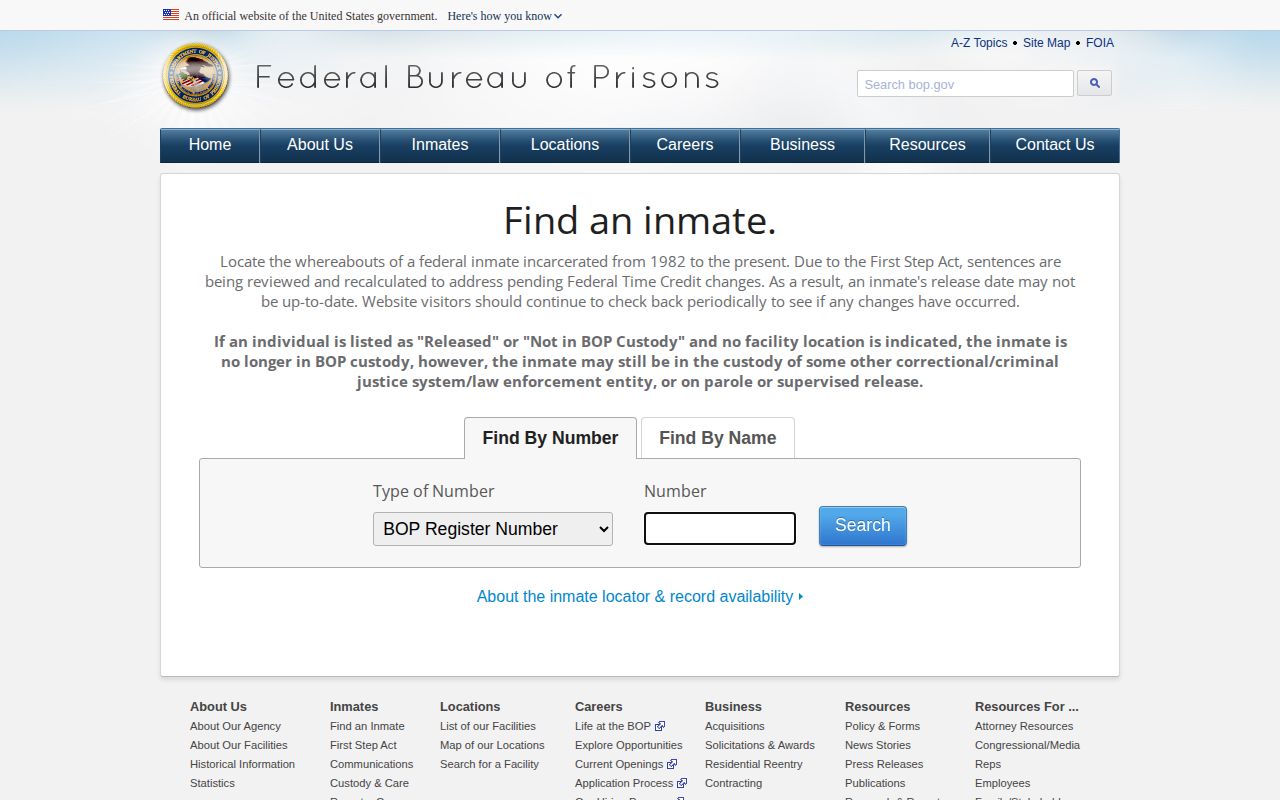
The screen is a nationwide federal search. A matching record does not imply that the person was confined in Nemaha County or even in Kansas.
Read Federal Released Results
A BOP result can show name, register number, age, race, sex, a release date, and location. When the location reads “RELEASED,” BOP says the person is no longer in its custody. The displayed date is the federal custody-release date. That is an affirmative federal record, but its meaning ends at the BOP boundary.
The result does not decide whether the person began a term of supervised release, entered ICE detention, faced a state matter, or moved into another custody system. Supervised release is a court-ordered period monitored in the community after federal prison. It is not the same as BOP incarceration. Read the federal judgment and later docket entries to understand the term and any court action.
The BOP’s locator records explanation describes coverage and the fields shown. Its coverage image makes the distinction visible:
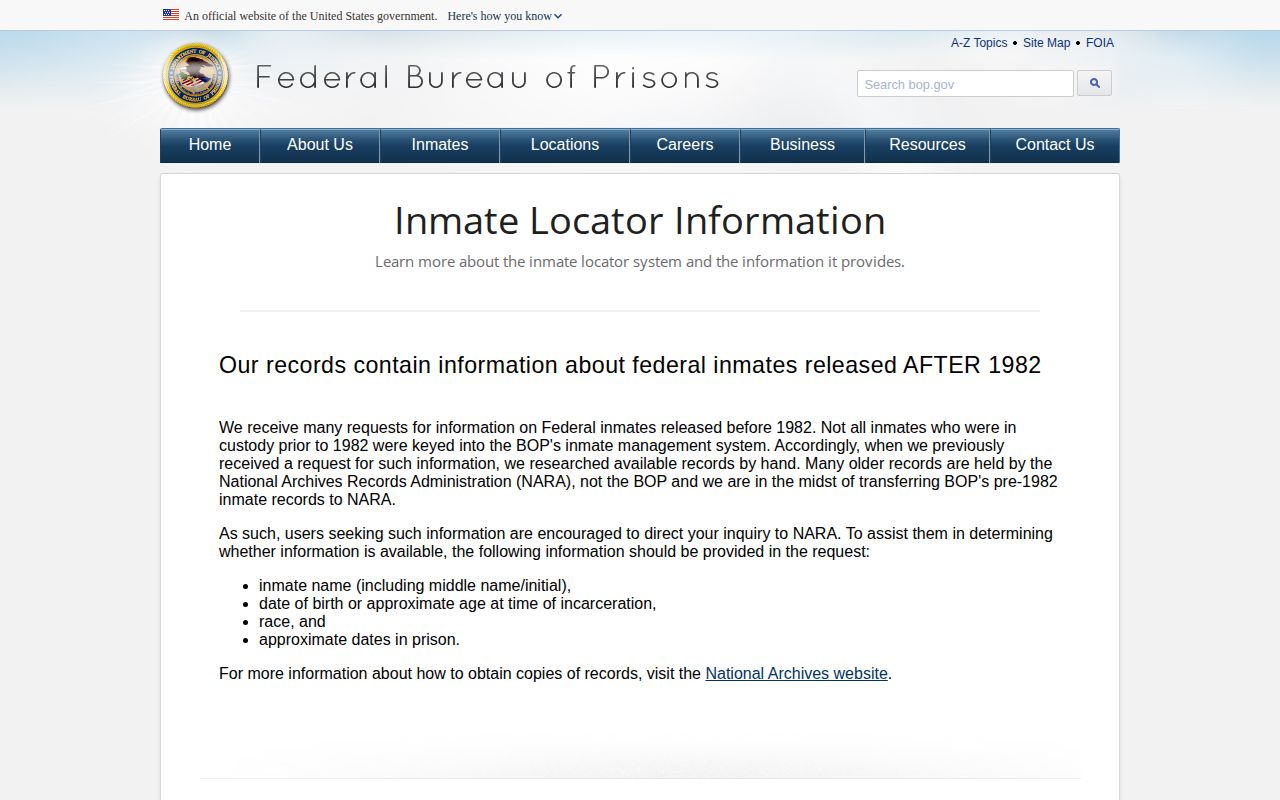
Use the actual past release field for confirmation. A projected federal date can change with sentence calculations or later court action.
Federal Pretrial Custody Gaps
USMS manages many people who await federal trial, sentence, designation, or transport. Its Prisoner Tracking System can contain processing, facility-placement, and disposition information before BOP delivery. The official research sweep found no comparable public USMS name locator. A blank BOP search may therefore mean the person has not entered BOP’s searchable stage, not that the county release returned the person home.
Start with the Sheriff’s receiving-agency field if the person left Nemaha County Jail. Then search the federal court case for the detention order, release order, judgment, or transport-related filing. The U.S. Marshals prisoner information route is the agency fallback. A narrow USMS Freedom of Information Act request can seek custody-processing or disposition material tied to an identified person and time period.
- Pretrial detainee
- A person held while the federal case is pending, before final sentence.
- Designation
- The BOP process of assigning a sentenced person to an institution.
- Remand
- A court order placing the person into custody.
- Supervised release
- Federal community supervision imposed by the sentencing court.
Older Federal Release Records
The public BOP locator generally reaches back to federal prisoners released in 1982. An older no-result is not evidence that no federal imprisonment occurred. BOP directs historical inquiries to the National Archives. The request should include the person’s full name, date of birth or approximate age, race, and approximate imprisonment years. Those details help staff distinguish similar names.
For a post-1982 record that lacks needed detail, use BOP’s FOIA process and the identity-certification form the agency links. Request a specific existing record, such as the releasable custody history or release transaction for a stated period. The federal docket may answer the sentence imposed and the court-ordered supervision, while BOP answers its own physical custody.
A negative search can also result from name variation or use of a commitment name. Try the federal number before expanding name variants. Do not match two people on name alone. Register number, age, and case information are stronger identifiers.
Archived records and current locator results answer different needs. The National Archives can help trace an older prison term, but it will not supply a live location. BOP FOIA can seek agency records, yet public release depends on federal access and privacy rules. The court docket remains the source for the judgment. Keep the archive response, BOP release record, and court order as separate documents with their own dates.
Confirm Nemaha Federal Transfers
The Nemaha County Sheriff’s booking and release entry should show when local custody ended and name the receiving agency when the person was handed off. That county timestamp and the federal record document different sides of the movement. If the local entry says “released to USMS,” the word released describes departure from Sheriff custody. It does not describe a community release.
Follow the custody chain in order:
- Nemaha County admission and release timestamps
- Receiving agency or federal hold named by the Sheriff
- Federal court detention or release order
- USMS status before BOP designation
- BOP location and eventual actual release date
KASPER is not the federal search. Kansas VINE is a participating county-jail notification system, not a BOP release archive. ICE ODLS has its own search rules and limited recent-release window. Using each locator only for its assigned system avoids interpreting a blank result as proof.
A later booking can also coexist with a valid old BOP release date. The federal locator’s past entry documents the end of that federal custody period. It does not update itself to describe a later county or state arrest. Check the event dates, register number, and case before linking records across systems. A chronological custody chain is more reliable than one current search screen.
Federal Date and Identity Checks
A federal result can contain several facts that look conclusive but require context. The release date speaks to BOP custody. It may not be the sentence end if supervised release follows. “Not in BOP custody” does not say whether the person is in USMS, ICE, state, or local custody. A federal judgment sets the sentence, yet later credit and court events can affect custody calculations.
First Step Act calculations and other lawful changes can alter a projected date. For a person who has already left BOP custody, favor the past actual locator result and the federal docket. For a future date, ask BOP or authorized counsel about the current calculation rather than applying a simple share of the sentence.
Names also change across records. The commitment name may differ from a commonly used name. Record the source’s label and the federal register number. If the BOP and county entries appear to refer to the same person, compare birth data and the federal case before treating them as one identity.
For a released federal prisoner, the docket may show a later petition, violation allegation, or revocation tied to supervised release. A revocation can return a person to custody after time in the community. It does not erase the earlier BOP release. Read each event in date order and confirm the agency that held the person during each period.
No official research identified a fixed federal release time, travel plan, transport service, property procedure, or release payment for a person connected to Nemaha County. Those details vary by the actual BOP institution and release plan. Contact the named institution or authorized federal office when current arrangements are needed. Do not apply a practice from one federal facility to the nationwide system.