
No Nemaha 72-Hour Release Feed
Nemaha County’s official jail page does not publish a rolling three-day release view. The Sheriff Jail Roster is a current-custody list. It offers name and booking-number searches, a current count, and booking entries. No released, archive, 24-hour, 48-hour, or 72-hour control appears. The agency also does not state a public refresh cadence or a postrelease retention period for the web display.
That absence matters more over a three-day span. Several people can enter and leave custody while the live page continues to show only those held at the moment it is checked. An older screenshot still cannot identify all releases in the intervening period. Nor does a vanished booking reveal whether the end event was bond, sentence completion, court order, dismissal, or transfer. The complete route is a request for the underlying log bounded by exact timestamps.
The image from the official Sheriff roster shows the current-only format. Its lack of a release tab is the point of the illustration.
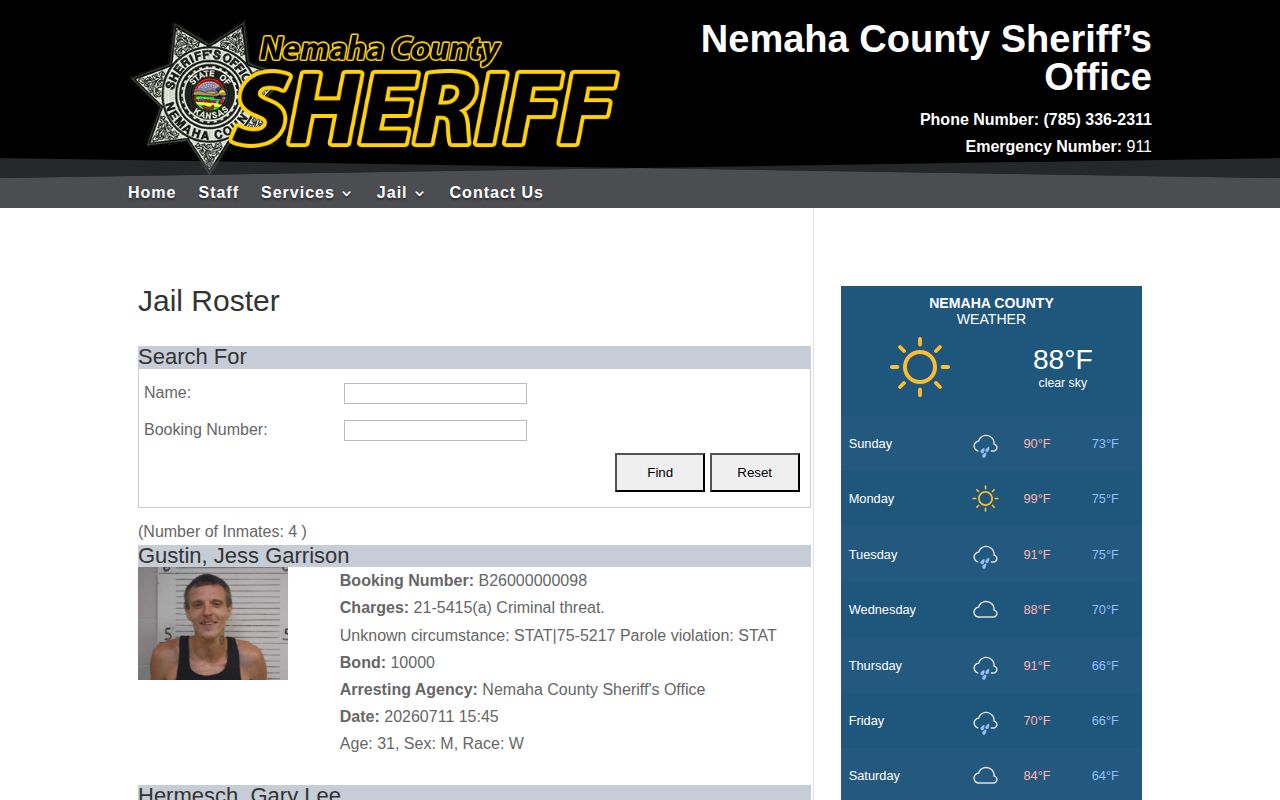
The roster can supply a booking number before an entry drops, but the release timestamp must come from another agency record.
Request Nemaha Three-Day Releases
A three-day inquiry should define the window instead of asking generally who left “recently.” Specify the first date and time, the final date and time, and the time zone. This avoids disputes about whether 72 hours means three calendar days, the prior three dates, or a rolling period counted back from the moment of the request. It also helps the custodian locate existing jail log entries without building a new report.
- Choose the exact 72-hour interval and write both endpoints.
- Search the live roster for any known name and save the booking number if present.
- Follow the Nemaha Sheriff written-records process in person or by mail.
- Ask for each release timestamp, authority or type, and receiving agency within the interval.
- Match each event to VINE and the related court docket when identity or disposition is unclear.
- Follow a transfer into KDOC, federal, or immigration custody through that system’s locator.
One clear request can seek a 72-hour record set. If only the first day is later needed, filter the produced records by their actual timestamps. Do not assume a shorter result can be reconstructed from changing roster screenshots. The Nemaha County 24-hour releases method applies when the required interval is limited to one rolling day.
Note: The Sheriff may respond with records, an estimate, a legal denial, or notice that more time is required.
Nemaha 72-Hour Release Fields
A useful three-day record set has enough detail to sort events by time and type. A bare list of names does not show whether two similar names refer to the same person or whether a jail exit was a transfer. Requesting the booking number, timestamps, and destination gives each row a custody context.
| Requested field | Use across the 72-hour window |
|---|---|
| Name and booking number | Separates identities and links each release to one booking episode. |
| Admission timestamp | Shows when county custody for the episode began. |
| Release timestamp | Determines whether the event falls within the exact three-day interval. |
| Release authority or type | Distinguishes bond, court order, completion, dismissal, and transfer. |
| Receiving agency | Identifies a handoff to KDOC, another jail, or federal custody. |
| Charge and bond details | Connects the custody event with the correct court case and public bond facts. |
The current roster has different fields: photograph, booking number, charges, bond, arresting agency, booking date and time, age, sex, and race. Its date is a booking date, not a release date. A release record can also show whether the person left on own recognizance, surety, or cash bond. Those terms describe how release security was handled, not whether the charge ended.
Nemaha Weekend Release Timing
A 72-hour interval is useful when the period crosses several dates or when a person was last known to be held before a weekend. Yet no official Nemaha source states a fixed jail release hour, weekend-release rule, or holiday-processing schedule. It would be unsafe to claim that all weekend events appear on the next business day or at a set time. Physical release, staff entry, VINE transmission, and a later records response can occur on different schedules.
The safest method is to widen the requested endpoints enough to cover the known period, then use the actual timestamp in the produced record. If the window begins Friday afternoon and ends Monday afternoon, write those exact dates and times. Do not substitute “over the weekend” and leave the bounds to interpretation. For a person with a court appearance, the docket may show the bond or order that authorized release, while the Sheriff log supplies the physical custody end.
Note: No Nemaha jail transportation program, property-return procedure, or set release hour was verified in the official research.
Nemaha Release Disappearance Rule
The county roster’s most important quirk is also its clearest design feature: it reports current inmates. Removal is expected after county custody ends. What disappears with the entry is the context needed to interpret the change. Bond, time served, dismissal, sentence completion, and a transfer can all lead to the same absent-name result on the public page.
Use an affirmative source for the next state. The Sheriff booking and release record gives the release line. Kansas VINE may show the latest participating county-jail custody status. The criminal case can identify a bond, dismissal, sentence, revocation, or other order. If the release record names KDOC as the receiver, KASPER can show an institution, parole or postrelease supervision, or discharge. Each term has a distinct meaning.
- Community release
- The person leaves physical jail custody without an immediate handoff to another custodial agency.
- Transfer
- The county jail stay ends because another agency takes custody.
- Postrelease supervision
- The person is outside a state prison but remains under KDOC control.
- Discharge
- KDOC records the end of the represented correctional obligation, subject to any other active case.
Nemaha Release Request Costs
The Kansas Open Records Act allows reasonable fees for staff time and copies. Nemaha’s July 13, 2023 Sheriff schedule lists staff time for access, review, and redaction at $20 per hour. It also lists copy, fax, and media charges, along with cash or check payment. Because the schedule can change, the current agency estimate controls.
A narrow request can reduce both ambiguity and cost. Include the 72-hour endpoints and ask for existing release-log fields. Electronic copies are preferred where available. Request an itemized estimate before fees above a chosen limit are incurred. If an exempt item is mixed with public information, ask for redaction and production of the releasable balance rather than treating the whole record as unavailable.
K.S.A. 45-218 sets a response deadline at the end of the third business day after receipt. That response is not always the completed production. It may provide the record, explain a delay and give the earliest practical time, request payment, or state a legal basis for denial. K.S.A. 45-219 governs fees and copies, while K.S.A. 45-221 lists exemptions.
Verify Nemaha Three-Day Results
Start with the system that held the person. For a Nemaha County Jail episode, compare the release entry with Kansas VINE and the court case. VINE is a county-jail notification and status channel. A delayed feed, transfer, brief rebooking, or wrong identity match can limit a result. The Sheriff record and court order remain the stronger documentary pair.
For a state prison or state supervision record, use KASPER. It covers people sentenced to the custody of the Kansas Secretary of Corrections since 1980, including many people in prison, under post-incarceration supervision, or discharged. It does not include every local jail stay. KDOC says KASPER updates on working days rather than in real time, so its date and status still require careful reading.
Federal cases use different routes. The Bureau of Prisons locator can show a past federal prisoner’s released status and date for covered records. A federal pretrial detainee may instead be under U.S. Marshals control. ICE has its own locator and limited recent-release coverage. A county release to one of those agencies should be recorded as a transfer unless a later receiving-agency source proves community release.
A negative result is weak evidence in every system. Names vary, uploads lag, and each database covers a different population. Match full name with date of birth, booking number, KDOC number, or another stable identifier. Record the exact label on each date, since booking date, actual release date, anticipated release date, and discharge date do not mean the same thing.