
KDOC Releases From Nemaha Cases
A Nemaha County defendant enters the Kansas Department of Corrections system after commitment to the Secretary of Corrections. The person may be assigned to an institution anywhere in the state. Leaving Nemaha County Jail for that assignment is a transfer, not a community release. The county jail record should name KDOC or another receiving authority, while the state record becomes the main source for later prison location, supervision, and discharge.
Community status also needs care. Parole, conditional release, and postrelease supervision mean the person has left the prison institution but remains under KDOC control. “Discharged” generally means the KDOC control represented by that record has ended. A person can have more than one sentence or case, so one discharged line does not automatically prove that no other custody or supervision is active. Confirm identity and read the full detail.
| KASPER status | Custody meaning | Next check |
|---|---|---|
| Institution or incarcerated | Still in KDOC physical custody | Facility and sentence details |
| Parole or postrelease | Outside prison under supervision | Listed status and parole office |
| Absconder or warrant notation | Supervision has not ended | KDOC or issuing authority |
| Discharged | Shown KDOC control has ended | Check for other active sentences |
Search KDOC Nemaha Releases
KASPER stands for Kansas Adult Supervised Population Electronic Repository. Begin at the KASPER disclaimer, accept its terms, and proceed to the search. A KDOC number is the cleanest key. If it is not known, use the person’s last and first names plus any filters the live form offers. Search results are only the start. Open the person detail to inspect current status, supervision, convictions, sentence information, and date labels.
- Enter the KDOC number when available, or search the exact legal name.
- Match birth year, physical details, photograph, and conviction information before choosing a record.
- Open the detail and copy the current status exactly as displayed.
- Review institution or supervision information and each sentence separately.
- Record each date with its full label. Do not turn a forecast into an actual release.
- Contact KDOC records when a movement, supervision, or discharge label is unclear.
The official search form shows the state’s name and KDOC-number routes:
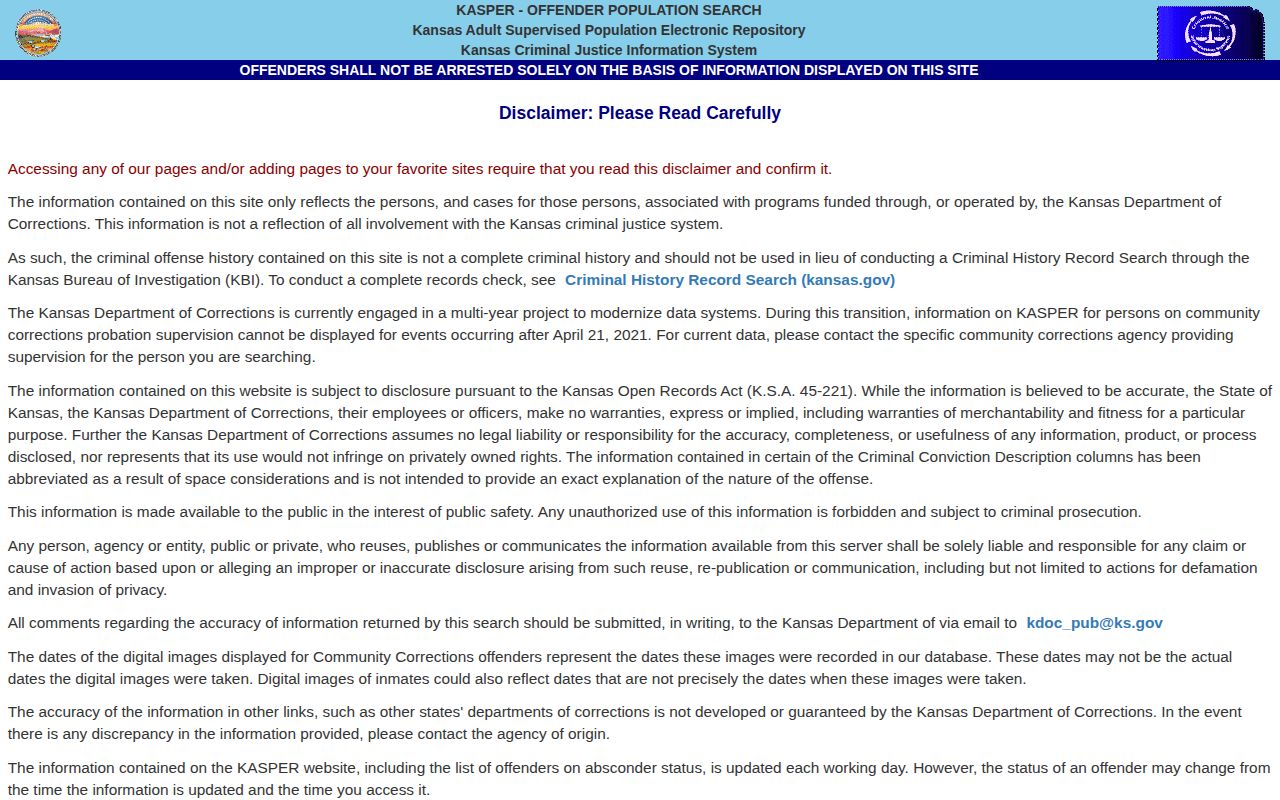
That form searches the statewide supervised population. It should not be used to infer that a Kansas institution is located in Nemaha County.
KDOC Date Labels Matter
KASPER sentence details may contain date concepts used to track or calculate progress through custody. Public labels can vary by record and sentence era. A detail might show an earliest possible release date, conditional release date, maximum release date, or another projected or release label. Not every field appears in every record. Preserve the exact wording and do not promise a date that the live state record does not show.
A projected date is a forecast. It can change because of sentence-credit rules, program credit, disciplinary action, court modification, sentence aggregation, detainers, or other lawful events. An actual release or movement record documents what happened. A discharge status addresses the end of KDOC control for the represented sentence. Those three concepts should never be collapsed into one “release date.”
- Projected date
- A calculated future date that can change.
- Release
- Departure from an institution, often into supervision.
- Postrelease supervision
- Community supervision that follows prison under Kansas law.
- Discharge
- The end of KDOC control shown for the represented sentence.
For a focused explanation of forecasts, Kansas credits, and changing date fields, use the Release Date Lookup. An exact future date should come from the current KDOC record or authorized staff, not a percentage applied to the court sentence.
KDOC Records for Nemaha Releases
KASPER is a public lookup, not the full agency file. When the public status does not answer how or when a transition occurred, request the movement, release, supervision, or discharge record from KDOC. Identify the person by KDOC number, full name, and birth information. Name the specific record and time period. Separate a request for an actual release transaction from one for a projected calculation.
714 SW Jackson Street, Suite 300
Topeka, KS 66603
785-296-3317
The KDOC online records portal provides the state request route. Kansas Open Records Act rules permit lawful exemptions, redaction, and reasonable fees. A narrow request is more useful than asking for every document. For example, ask for the releasable movement and status entries that show transfer from an institution, the effective release status, and the eventual discharge, if any.
The KDOC portal is visually distinct from the public offender search:
Use the portal when KASPER’s public summary lacks the transaction detail needed to verify the release or discharge.
Nemaha Jail Versus KDOC Release
A county jail stay and a KDOC sentence belong to different record systems. The Nemaha County Sheriff’s roster covers current jail custody and may include people awaiting trial, serving local time, or waiting for transfer. KASPER covers people committed to KDOC and adults under covered state supervision. A county-jail-only booking may never appear in KASPER.
When a name leaves the Nemaha roster, obtain the county release disposition first. If it says the person was released to KDOC, search KASPER next. If it says bond, dismissal, or local sentence completion, the county release record and court docket are usually the right sources. Kansas VINE is for adults in participating county jails and does not cover KDOC prisoners housed in state facilities.
County of conviction is also not a residence field. A state parole list or KASPER case tied to Nemaha may describe where the offense was prosecuted, not where the person lives after release. Avoid using that label as a destination.
KASPER Negative Result Limits
No KASPER result is not proof that a person was never confined or has been released. The person may have had only a county-jail case, the name may differ, the record may require a KDOC number, or public access may be limited. Identity matching should use more than a shared name. Compare age or birth year, physical data, photograph, county and offense information, and sentence details.
The official KDOC locating information explains KASPER’s scope and mechanics. The state’s public screen also carries an important disclaimer before search:
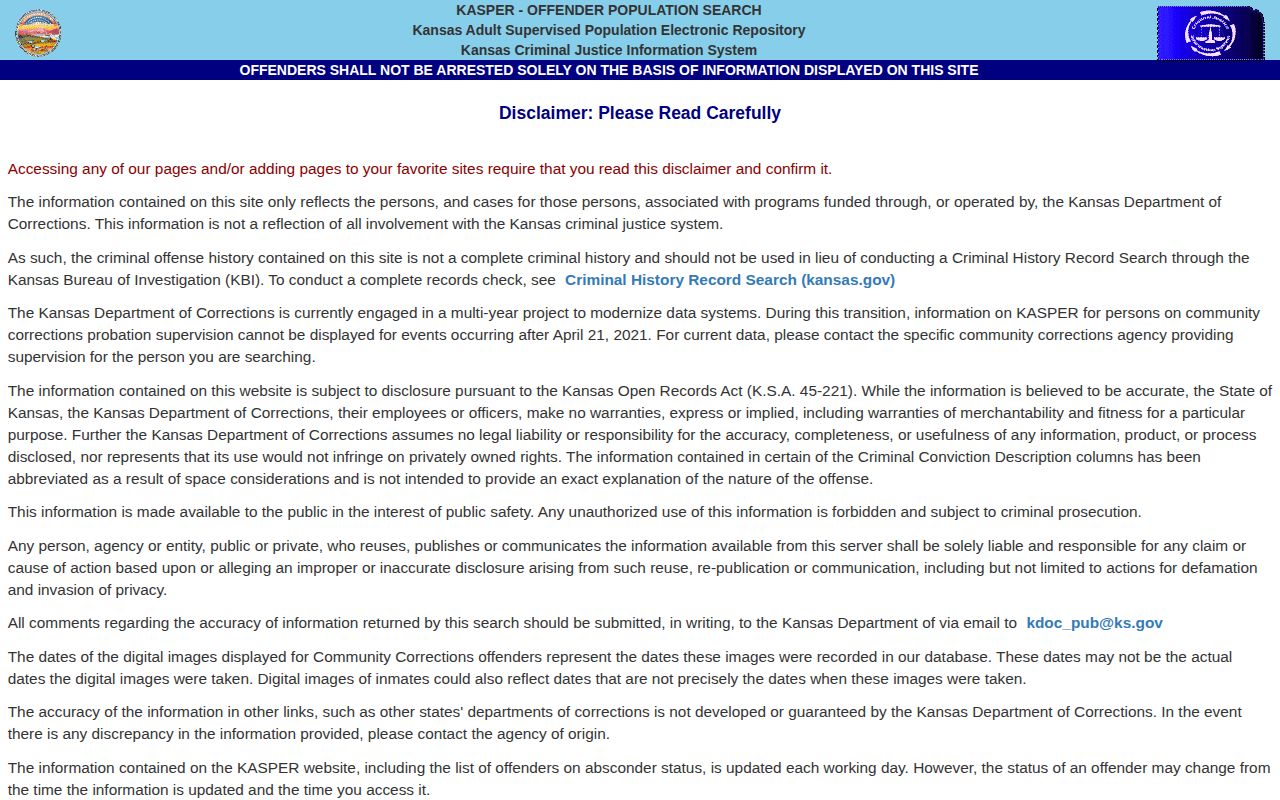
The disclaimer reinforces that the public repository must be read as agency data with stated limits, not as a complete answer for every Nemaha County jail episode.
If a lawful state record appears to conflict with a county docket, check whether the dates describe different events. A county transfer date, prison admission date, projected release date, actual institutional release, and final supervision discharge can all be correct at different points in one case.
A KASPER photograph is also a state corrections identification image. It may help confirm the right person, but it is not proof of current incarceration and is not necessarily the same image made at the Nemaha County Jail. Record the image source and date context. If the state and county records use different names or photos, rely on the KDOC number, booking number, birth data, and case details before drawing a match.
KDOC Supervision After Release
KDOC Community and Field Services administers parole and postrelease supervision. The Kansas Prisoner Review Board handles parole-related decisions for eligible cases. Court probation is different and may be managed through court services or community corrections. A KASPER status should guide the next call instead of an assumption that all people outside prison report to one office.
Parole is a release decision used in eligible cases, often tied to older indeterminate sentences. Postrelease supervision is the supervision term that follows prison for many guideline sentences. Probation is ordered by a court, often instead of prison. An absconder notation means the agency reports that the person has stopped complying or cannot be located; it does not mean the term ended or prove present jail custody.
K.S.A. 22-3717 governs parole eligibility, release, and postrelease rules across several categories. K.S.A. 21-6821 addresses credits for guideline sentences, while K.S.A. 22-3725 applies to certain older crimes. The rules depend on offense date and sentence type. The simple claim that every person serves one fixed percentage is not accurate.
The Atchison Parole Office is the listed KDOC parole route serving Nemaha County, but the current state directory should control because contact details can change. It does not supervise every county probation case. When KASPER shows state parole or postrelease, follow the state directory. When a court order shows probation, use the supervising court services or community corrections route named in that order.